
Every second of every day, Earth is bombarded by particles from outer space. Some of these particles are obstructed by our planet's atmosphere but can spray down other particles, while others can zoom through the atmosphere and easily pass through anything, including us.
You won't feel these particles darting through you, but it raises a question: How many cosmic particles are actually passing through your body at any moment?
The most common particles that stream through us from outer space are ghostly specks known as neutrinos. "An estimated 100 trillion neutrinos pass through each of us every second," Michael Pravica, a professor of physics at the University of Nevada, Las Vegas, told Live Science.
Neutrinos barely interact with regular matter. Nearly all of them pass through us and the rest of the planet without leaving a trace. "The fact that most of these particles never interact with us demonstrates that there is an underlying reality to our existence, much of which we are not even aware of," Pravica said.
Neutrinos originate from nuclear activity. Nearly all of the neutrinos zipping through us come from the nuclear fusion reactions that power the sun, although some neutrinos originate much farther away, even other galaxies, Lu Lu, an assistant professor of physics at the University of Wisconsin-Madison, told Live Science.

Sign up for our weekly Life's Little Mysteries newsletter to get the latest mysteries before they appear online.
Other extraterrestrial particles that continually strike Earth are cosmic rays — electrically charged, highly energetic particles that travel at nearly the speed of light from all directions, according to the University of Chicago. Although the sun's nuclear reactions produce very-low-energy cosmic rays, the vast majority of cosmic rays come from beyond the solar system. These may be created when faraway stars explode as supernovas, matter falls into supermassive black holes, or galaxies collide, per the University of Chicago.
Cosmic rays are mostly either protons, which are the nuclei of hydrogen atoms, or the atomic nuclei of heavier elements (which contain both protons and neutrons), such as helium or iron. Electrons and positrons (the antimatter counterparts of electrons) also make up a tiny fraction of cosmic rays.
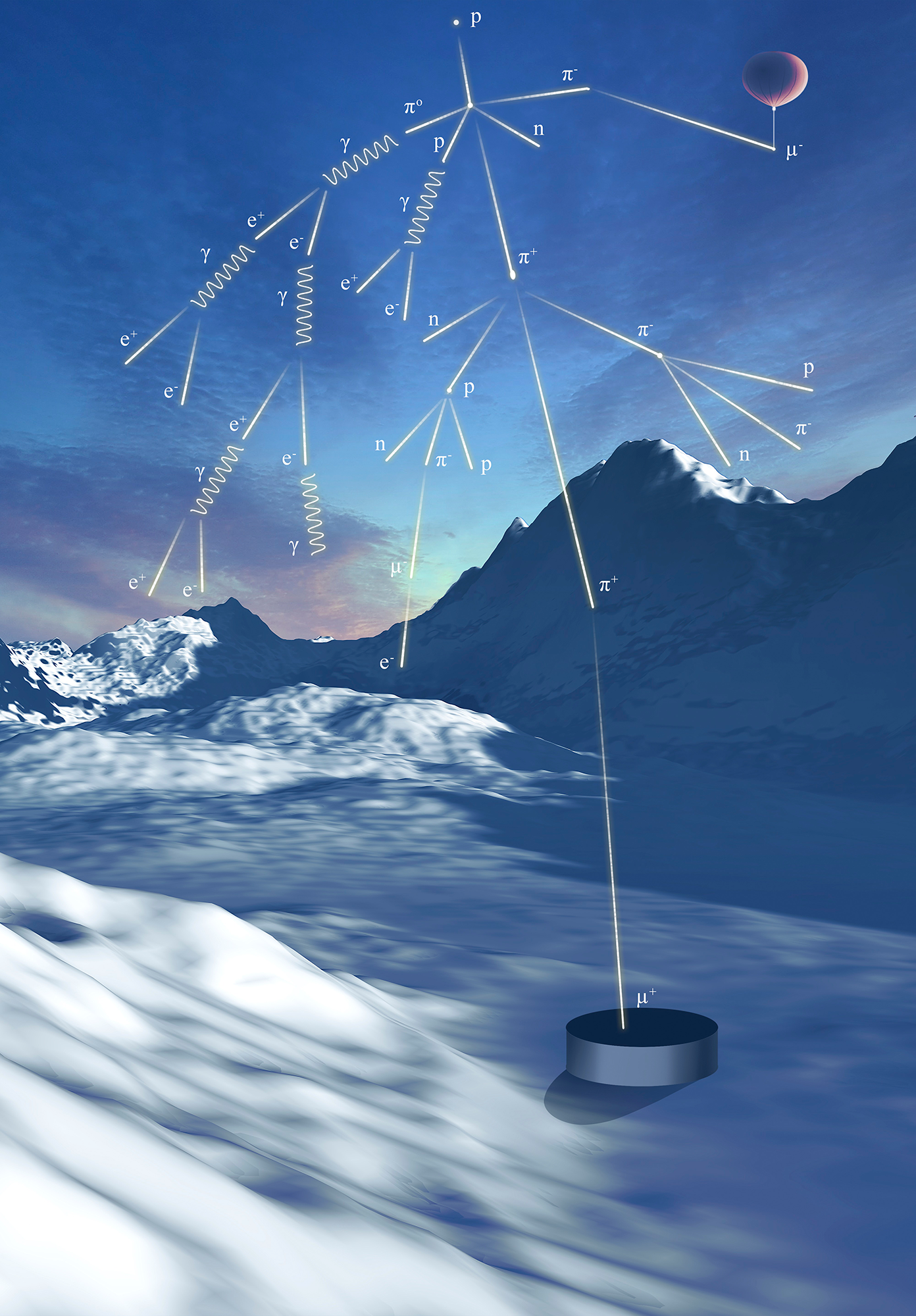
When cosmic rays hit Earth, they are generally blocked by molecules of air high in our planet's atmosphere, Lu said. However, these collisions can generate showers of secondary particles that make it to the ground. These include muons, which are negatively charged subatomic particles that are much like electrons except more than 200 times more massive.
At sea level on Earth, about one muon passes through per 0.15 square inch (1 square centimeter) per minute, Lu said. "For a person, the number ranges from tens to hundreds per second," she noted. "Roughly one or two pass through a hand each second."
Because muons are electrically charged, they can interact with matter they encounter. "Their paths can be made visible in a cloud chamber," a box of vapor in which a trail of mist can be seen when a charged particle streaks through the vapor, Lu said.
In contrast, neutrinos are not electrically charged. They also have almost no mass. These two qualities make it very difficult to detect neutrinos, which is why they're often dubbed "ghost particles."

Detecting cosmic particles
Scientists estimate the number of neutrinos that pass through our bodies by recording "the tiny fraction that happen to collide with matter inside or close to a detector," Lu said. "Everything else follows by working backward from those few."
For instance, the IceCube Neutrino Observatory in Antarctica surrounds 0.24 cubic mile (1 cubic kilometer) of ice with thousands of light sensors. "When a neutrino interacts with an atomic nucleus in the ice, it produces fast-moving charged particles, and those particles emit a faint flash of blue Cherenkov light, which the sensors record," Lu said. "From the pattern and brightness of that light, we can reconstruct the neutrino's energy and direction."
To estimate how many neutrinos pass through Earth based on these recorded interactions, "we account for the size of the detector, how long it operated, its detection efficiency, and the probability that a neutrino of a given energy interacts at all," Lu said. "It is a bit like estimating the number of fish in a river from the few caught in a very coarse net. If you know the size of the net, how long it was in the water, and how easily fish slip through it, you can work backward to the whole river."
When it comes to the neutrinos that IceCube studies, although trillions pass through each of our bodies every second, nearly none of them interact with our atoms. "You would expect no more than roughly one interaction in your body, perhaps a few, over an entire lifetime," Lu said.
These rare interactions would have virtually no effect on us. Given how little energy such an interaction would deposit, such neutrinos "pose no health risk at all," Lu said.
In contrast, the showers of particles resulting from cosmic ray impacts can potentially affect human biology. "At ground level, muons dominate the penetrating charged particles reaching us from cosmic-ray showers," Lu said. "At higher altitudes, and especially during air travel, other secondary particles, particularly neutrons, contribute a significant share of the biologically relevant dose."
Still, any effects from these cosmic-ray showers are generally small. "For an average person, cosmic radiation contributes roughly 0.4 millisieverts per year, about the same as a few chest X-rays spread across the year, out of a total natural background of about 2.4 millisieverts from all sources," Lu said. "The dose varies with altitude, latitude and shielding. At typical ground level, muons and other cosmic-ray particles are not considered a significant health hazard. Life on Earth has been bathed in them from the beginning."
So, every second, there are about 100 trillion neutrinos and tens to hundreds of muons passing through your body per second, and maybe a tiny scattering of neutrons and other cosmic particles or debris from cosmic particles impacting the atmosphere.
These cosmic particles may lead to a variety of discoveries. For instance, scientists have used muon detectors to identify hidden passageways in pyramids. And "high-energy neutrinos allow us to study some of the most violent and otherwise hidden environments in the universe, such as the regions surrounding black holes, exploding stars and other powerful cosmic accelerators," Lu said.
"Because neutrinos interact so weakly, they can escape from dense regions that light may not be able to penetrate," she explained. "They therefore carry information directly from the places where some of nature's most energetic particles are produced."
All in all, "the particles streaming through us are a constant reminder that we are not separate from the universe," Lu said. "We are part of a cosmic story stretching back 13.8 billion years."
See how much you know about black holes with our black hole quiz!
from Latest from Live Science https://ift.tt/nbj78sw
via IFTTT